








When people think about industries being reshaped by technology right now, telecoms rarely makes the list. It is old, it is regulated, and to most people it is invisible until something goes wrong. But LoopUp Co-Founder and Co-CEO Steve Flavell would argue that is exactly what makes this moment so interesting. Speaking recently on the Software Oasis Podcast Network’s Software Spotlight, Steve made the case that enterprise telecoms, a market worth over $100 billion, is in the middle of one of the most significant restructurings in its 200 year history.
Steve knows this firsthand. LoopUp started in 2006 building one of the first ever BlackBerry apps, essentially turning the device in every executive’s pocket into a remote control for conference calls. It worked, and worked well, for over a decade, eventually taking LoopUp public on the London Stock Exchange. Then the pandemic reshaped how the world thought about meetings almost overnight, and the conference calling category LoopUp had built its name on was absorbed into something much bigger: unified communications. LoopUp had to reinvent itself, and today operates as a global telco helping multinational enterprises consolidate their telephony, fully integrated with Microsoft Teams.
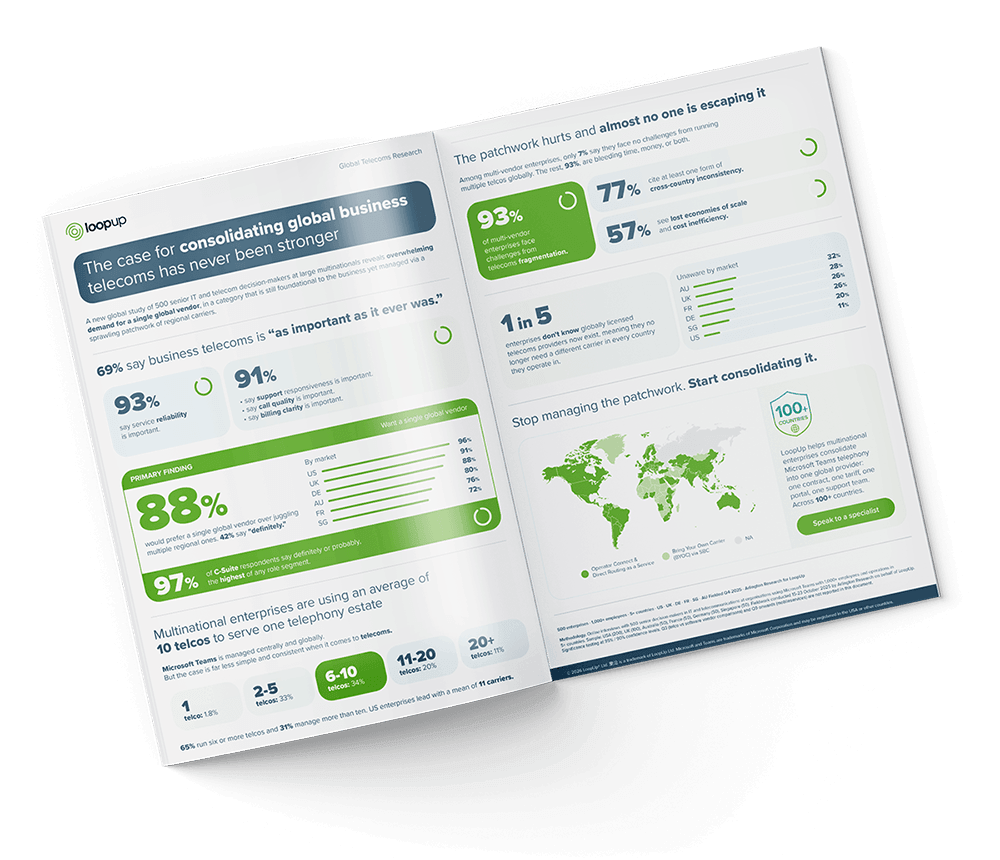
That reinvention gave Steve a front row seat to the forces now reshaping telecoms more broadly, and on the podcast he broke them down into five distinct shifts happening at once. Copper networks are being retired in favor of VoIP, a change that is nearly complete globally. On premises phone systems are giving way to the cloud, with over 75 percent of enterprises having already made the move. Cloud telephony itself is being pulled into unified platforms like Microsoft Teams rather than living as a standalone service, a shift now supported by more than 100 Operator Connect providers. Enterprises are consolidating dozens of regional carriers down to a single global provider, the exact problem LoopUp was built to solve. And AI is starting to move telecoms from reactive troubleshooting toward predictive, personalized service.
Steve also floated where he thinks this all heads next: a future where landline and mobile numbers converge into a single business number that rings on every device, ending the need for enterprises to manage two number types and two sets of vendors entirely.
The conversation did not stop at trends. In a live audience Q&A, Steve fielded pointed questions on governance in regulated, multinational Teams rollouts, the operational headaches of number porting during carrier switchovers, and how enterprises can get the efficiency of one global vendor without losing the resilience of strong local carrier relationships, something LoopUp solves through a network of 25 (and growing) regional carrier partners chosen for their strength in each local market.
Listen to the full podcast episode here: https://podcasts.apple.com/us/podcast/steve-flavell-on-reinventing-loopup-amidst-telecom/id1706579217?i=1000779593984
About LoopUp
LoopUp helps multinational enterprises consolidate how they buy and manage their global Microsoft Teams telephony, offering phone numbers and full cloud-based, PSTN-replacement service in over 100 countries.
We liberate multinationals from the frustrations, complexities, and inefficiencies of working with multiple regional carriers, each with their own contracts, pricing, support teams, and management portals. LoopUp offers a single and consistent global solution, combining design, deployment, service delivery, and support – provided globally and all integrated with Microsoft Teams. LoopUp is headquartered in London with operations around the world.