








Contents
When Honeywell Technologies committed to standardizing collaboration on Microsoft Teams across a workforce spanning more than 100 countries, one thing became clear almost immediately: the company’s existing telephony estate, built up over years of regional growth and acquisition, was not going to keep pace.
About Honeywell Technologies
Honeywell Technologies is a global automation and industrial technology company operating in more than 100 countries across North America, Europe, Asia Pacific, Latin America, the Middle East and Africa. It helps customers in manufacturing, energy, buildings, healthcare, life sciences, logistics and data centers improve productivity, operational efficiency, safety, security and sustainability through software-connected solutions and intelligent automation, part of what the company describes as its evolution from automation to autonomy.
Oliver Anderson, Senior Architect in the UCC space at Honeywell Technologies, leads architecture and strategy for the company’s global collaboration and communications platforms, including Microsoft 365, Microsoft Teams and Teams calling. His role centers on driving Honeywell Technologies’ digital workplace transformation: delivering scalable, secure, user-centric communication for its employees around the world, known internally as Future Shapers.
The trigger for change: A Teams transformation that legacy telephony couldn’t keep up with
“The turning point was our broader Teams transformation initiative. As we standardized collaboration across the enterprise, it became clear that maintaining multiple legacy telephony solutions and regional carrier relationships would undermine the user experience and create a lot of unnecessary complexity.”
For Honeywell Technologies, telephony consolidation was never a side project bolted onto the Teams rollout. It was inseparable from it. “Telephony consolidation became a business imperative rather than just a technology modernization project,” Oliver says.
Underlying that was a broader dissatisfaction with how large telecom providers operated. “We recognized that our traditional telecom operating model was not keeping pace with the way our business was evolving,” he explains.
“A lot of large telecom providers were built around legacy processes: lengthy provisioning cycles, multiple support layers, and region-specific operating models. As we accelerated our Teams strategy, we needed a provider that was aligned to a cloud-first, globally managed approach, rather than one rooted in legacy telephony.”
The goal was a single, unified communications platform built around Microsoft Teams, since Honeywell Technologies is a Microsoft 365 organization at its core. Oliver wanted every future shaper (employee) to have a seamless experience for messaging, meetings, collaboration and voice, regardless of location. Voice was the piece still rooted in the old world.
The situation before LoopUp
Honeywell Technologies’ telephony estate reflected years of regional growth and acquisitions. “Our landscape, as it relates to telephony, really reflected many years of regional growth and acquisitions,” Oliver says. “We were managing multiple regional carriers, separate service contracts, country-specific numbering arrangements, and different support and administration processes across
numerous countries.”
“Beyond the technical complexity, we were operating within a traditional telecom model. Most of our interactions were driven through portals, ticket queues, and formal request processes. Getting answers or making changes often required navigating multiple teams and escalations, and there was rarely a single group that understood our global environment.”
Broad coverage was never the problem Honeywell Technologies needed solved. “While larger telecom providers offered broad coverage, the overall experience often felt disconnected from the agility and responsiveness we were seeking as part of our cloud transformation journey,” Oliver says.
“Before consolidation, Honeywell Technologies’ estate looked like this: 80+ carriers, 10+ management portals, an average provisioning time of two weeks, and an unpredictable timeline for bringing a new country or location online.”
Why LoopUp
The relationship began with a competitive RFP, which LoopUp won for Honeywell Technologies’ LATAM region. Delivery there was strong enough that Honeywell Technologies extended the engagement region by region, and what started as a single-region award became a global partnership.
What set LoopUp apart, in Oliver’s account, was not a longer feature list. It was a different category of provider. That difference showed up first in how the relationship itself was structured.
“Instead of directing us into generic support structures and lengthy escalation paths, they provided us with direct access to a dedicated account team that understands our environment and our business priorities,” Oliver says.
“LoopUp is a modern provider. They’re built around cloud communications, and they have a demonstrated level of agility, responsiveness, and engagement that’s been difficult to achieve through some of the larger providers still operating within more traditional telecom frameworks.”
“The differentiation with LoopUp was that they approached our discussion as a cloud communications partner rather than a traditional telecom provider. Most of the larger carriers focus on networks, contracts, and services. LoopUp focuses on outcomes: simplifying our Teams Phone deployment, reducing operational complexity, and creating a scalable global model for us.”
What changed
Honeywell Technologies migrated roughly 35,000 Teams Phone users globally as part of the consolidation. The headline numbers, in Oliver’s own words:
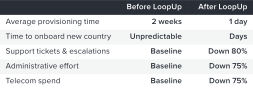
But for Oliver, the more important shift was not the count of carriers or contracts.
“The biggest change wasn’t simply reducing the number of carriers or contracts. It was moving away from a legacy telecom operating model and towards a modern cloud communications model that’s aligned with Microsoft Teams. We significantly simplified administration, improved governance, and established a more consistent global user experience. And just as importantly, we gained access to a dedicated account team that understands our environment and our business priorities. Instead of relying solely on portals, ticket queues, and layered support organizations, we have direct access to experts who can help us respond more quickly and operate much more efficiently.”
A partner through business transformation
Honeywell Technologies’ consolidation with LoopUp landed alongside one of the largest changes in the company’s history: the planned separation of its Aerospace and Advanced Materials businesses. That timing raised the stakes for getting the communications side right.
“Our modernization project and consolidation coincided with a major business transformation effort. As Honeywell Technologies prepared for the separation of our Aerospace and Advanced Materials businesses, our communications environment needed to support organizational changes affecting our people, systems, and operations around the world. The scale and complexity of that effort increased the importance of having a communications partner that could be agile and responsive. LoopUp has played a key role in helping us adapt to changing requirements, maintain continuity, and execute migration activities with confidence.”
Advice for IT leaders considering the same move
Asked what he would tell an IT director at another multinational standing where Honeywell Technologies stood a couple of years ago, weighing carrier consolidation against CFO pressure and a Teams rollout on the clock, Oliver doesn’t start with coverage or cost.
“Absolutely do not evaluate providers just on coverage, pricing, or features. Those are table stakes. Look at how they operate and how they support your business after the contract is signed. One of the biggest lessons we learned was the difference between working with a traditional provider and a modern cloud communications provider. The technology is important, but so is responsiveness, agility, and having access to experts who understand the environment. Those factors can have a significant impact on the success of a global Teams Phone deployment.”
In Honeywell Technologies’ words
“LoopUp has combined the global reach we need with the agility, responsiveness, and Microsoft Teams expertise that traditional telecom providers have historically struggled to deliver. The support structure is perfectly tailored for a large-scale organization like ours.”
As Honeywell Technologies continues what Oliver calls its journey from automation to autonomy, modern communications remains a foundational capability, and LoopUp remains part of how the company gets there.