








Voice remains one of the most trusted business communication channels. But as multinational organizations move from legacy PBX environments to cloud telephony delivered through Microsoft Teams Phone, the way voice is secured has not kept pace with the technology itself.
That gap is the focus of a recent TelecoNews piece urging telecom operators to rethink voice security, and encouraging enterprises to ask tougher questions of their providers. We are pleased to see Zach Bennett, Principal Architect at LoopUp and Microsoft MVP, featured, sharing insights based on real-world enterprise deployments.
Historically, voice security relied on closed networks and implicit trust between carriers. If a call was on the PSTN, the public switched telephone network, it was largely assumed to be legitimate. Controls existed, but they were often reactive and inconsistent.
This model no longer works. Voice traffic now crosses IP networks, cloud platforms, and multiple operators before reaching the end user. Attackers are quick to exploit the gaps this creates, using techniques such as spoofing and social engineering.
Zach highlights a core issue: responsibility for voice security is often unclear. Enterprises may assume their operator has it covered. Operators may assume the platform provider or the enterprise is responsible. Those blurred lines create real risk.
The message is not that voice is inherently insecure. It is that security must be intentional. It needs to be designed in, not bolted on, with clear accountability, better coordination between operators, and controls aligned to modern cloud architectures.
This closely reflects how we approach Microsoft Teams Phone deployments at LoopUp. When telephony becomes a cloud-based, PSTN-replacement service, security cannot be treated as a local issue. It must be consistent across countries, numbers, and users, and built into the service from day one.
For IT and UC leaders, the takeaway is simple: voice security should be a core part of telephony decisions, whether choosing Operator Connect, Direct Routing, or Microsoft Calling Plans. How calls are protected and managed globally matters just as much as coverage and cost.
As Zach notes in the article, enterprises that consolidate their telephony strategy are often in a stronger position. Fewer handoffs mean fewer blind spots, and clearer ownership makes issues easier to identify and resolve.
You can read the full article, including Zach’s comments, on TelecoNews here:
https://telconews.com/story/telecom-operators-urged-to-rethink-voice-security
About LoopUp
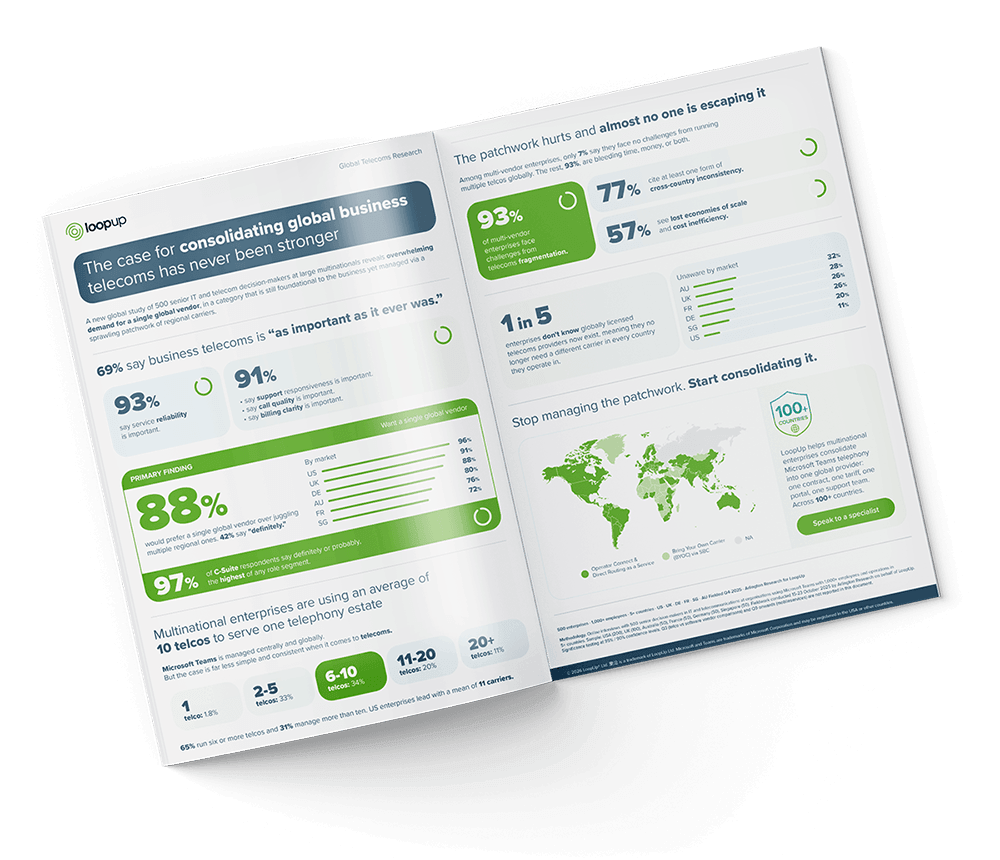
LoopUp helps multinational enterprises consolidate how they buy and manage their global Microsoft Teams telephony, offering phone numbers and full cloud-based, PSTN-replacement service in over 100 countries.
We liberate multinationals from the frustrations, complexities, and inefficiencies of working with multiple regional carriers, each with their own contracts, pricing, support teams, and management portals. LoopUp offers a single and consistent global solution, combining design, deployment, service delivery, and support – provided globally and all integrated with Microsoft Teams. LoopUp is headquartered in London with operations around the world.