








Contents
Overview
Collaboration technologies – encompassing features such as instant messaging, file-sharing, and video calling – are instrumental in supporting flexible work practices and remote work. The Covid-19 pandemic accelerated their adoption, as organisations hastened to implement remote work solutions, leading to the unprecedented rise of platforms like Microsoft Teams. This shift in work routines has revealed opportunities for enhancing productivity, business performance, and work-life balance. It seems likely that work routines will remain less office-centric in future.
Most people agree that we may never return to the old ways, as collaboration tools have proven their worth and are here to stay. This change coincides with the growth of cloud telephony – a trend with numerous benefits for businesses and employees. IT teams can deliver a consistent user experience globally, enhancing control, security, and reliability.
Cloud telephony eliminates the need for provisioning and maintaining on-premises telephony equipment, which simplifies IT environments and reducing cost. Users can securely communicate with customers and colleagues from any suitable internet-enabled device, allowing for greater flexible in work arrangements.
The logical next step for IT leaders is to unify collaboration tools with business telephony and transition all calling to the cloud.
A cloud-based telecommunications system enables users can make and receive calls on their business number from various internet-enabled devices – including PCs, desk phones, mobile phones, and tablets. And Microsoft’s cloud telephony solution integrates internal collaboration and external telephony through the Microsoft Teams interface.
This paper addresses questions organisations may have when considering this next step forward.
Cloud telephony eliminates the need for provisioning and maintaining on-premises telephony equipment, which simplifies IT environments and reducing cost.
What is cloud telephony?
Cloud telephony involves replacing physical PBX systems with a software-based phone system hosted in the cloud. This approach is particularly convenient for single-site organisations, as they can gain the benefits of working in the cloud and eliminating the need to maintain PBX hardware.
For larger businesses with multiple locations, particularly multinational corporations, cloud telephony offers even more advantages in terms of consistency across sites, streamlined management, and cost reduction. Cloud telephony can be an integral part of Unified Communications (UC), which may encompass voice communications, video conferencing, presence, fixed-mobile convergence, and instant messaging (IM). These components work together to create a cohesive communications experience across enterprise networks. UC is often provided as a service and hosted in the cloud.
With cloud telephony, users can make and receive calls from any location using any compatible device connected to the internet. This includes desk phone, softphone (software-based phones on PCs), and mobile phones. Integrating a collaboration tool like Microsoft Teams, which includes video calling, with cloud telephony brings business communications into the modern age and delivers numerous benefits.
How does Microsoft Teams provide cloud telephony?
Microsoft Teams is widely deployed by businesses for internal communications, leveraging chat, voice, video calls, and conferencing within the organisation. Increasingly, it’s being utilised for calls outside the organisation, necessitating a method for connecting external phone calls.
With cloud telephony, users can make and receive calls from any location using any compatible device connected to the internet.
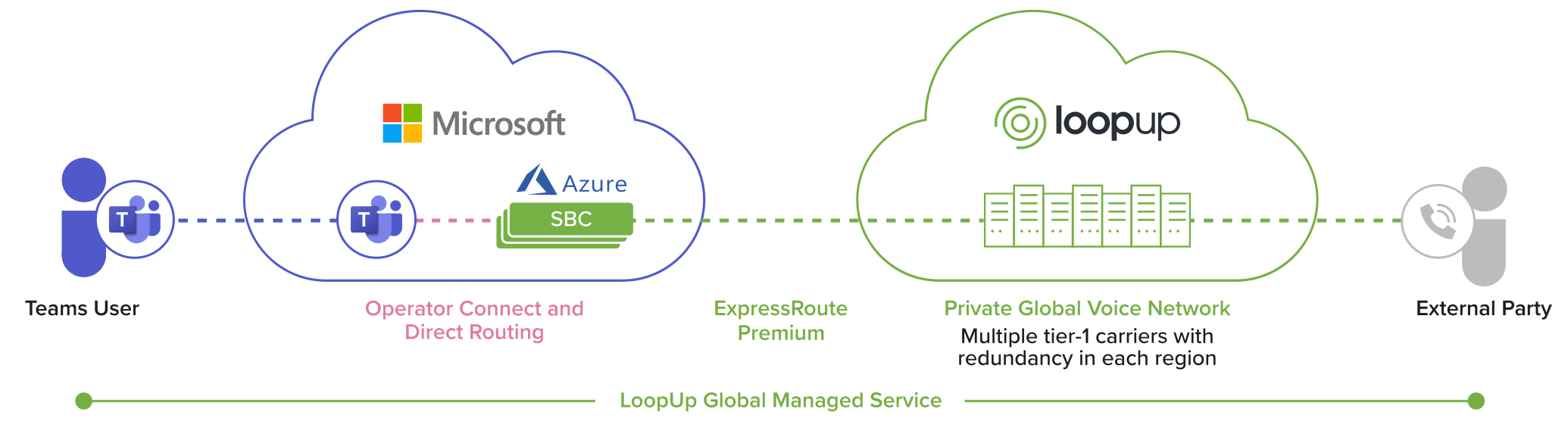
Microsoft offers its own cloud-based PBX, called Teams Phone, to provide cloud voice telephony within Teams. However, to enable phone calls, it needs to connect to the global PSTN network.
Microsoft provides three ways to achieve this, Microsoft Calling Plans, Operator Connect, and Direct Routing, with the latter two relying on a third-party managed service provider.

Microsoft’s Calling Plans are available in just 35 countries. Businesses can port their existing phone numbers or request new ones, and Calling Plans include a bundle of minutes for making external calls. These plans are suitable for smaller businesses operating in one country, but they are less appropriate for larger enterprises with multiple locations. Multi-national businesses would require multiple plans to cover each country, but the limited country coverage is insufficient for organisations with global presence. Calling Plans offer fixed bundles of calls without much flexibility and can be expensive with international call plans starting at £24 per user per month.
In contrast, an Operator Connect or Direct Routing solution from a managed service provider is generally more flexible and cost-effective. Microsoft provides limited or no assistance for larger, more complex solutions, whereas a managed service provider offers technical support, expertise, and PSTN connectivity, ensuring a smooth transition and successful implementation of a complex cloud calling solution. Businesses need local numbers (called DDIs – Direct Dial In) to receive calls, so they should work with a managed service provider that offers numbers in the required countries. Consequently, organisations with more than 100 people typically choose a managed service provider and the Operator Connect or Direct Routing option.
A managed service provider can usually port the organisation’s existing phone numbers to facilitate the transition to a cloud solution (except in some countries where this is not allowed). The entire cloud telephony system is managed centrally, with call charges for the entire organisation included in one agreement for economies of scale. Billing can be broken down by country or business unit to align with the internal accounting.
Adding Microsoft’s Teams Phone licence transforms Microsoft Teams into a comprehensive enterprise telephony solution. It integrates with the Microsoft 365 software suite, allowing users to make and receive calls directly from Microsoft Teams on any device. Incorporating a Calling Plan or partnering with a managed service provider partner for PSTN connectivity enables external calls to and from any global destination.
How does adding cloud telephony to Teams help users?
Cloud telephony is popular among users who need to work and stay in touch from any location. It offers improved, easier communication by providing access to the full suite of business telephony features from anywhere with an internet connection. Employees can use these features to make and receive calls on their business line, access voicemail, set call forwarding, and use features such as hunt groups.
Previously, individuals might have forwarded calls from their office phone to their mobile when they were out of the office, but this approach only works for inbound calls, and it generates call forwarding costs. It does not allow people to use outbound calling or the other PBX features from their mobile devices.
With cloud telephony, users can utilise their preferred internet-connected device running Microsoft Teams. They can also switch between PCs, mobile phones, tablets, and meeting rooms with ease.
Moreover, using Teams for telephony ensures that all collaboration and communication, both internal and external, is conducted through the same familiar interface across all devices, making it easier and more convenient to use. Remote work becomes easier and more efficient because employees can be contacted on their business number even when they are out of the office.
This simplifies staying in touch with customers who may not have their mobile phone numbers. When employees use their mobile phone for business telephony, calls are made and received with a data connection, reducing per-minute mobile charges.
As a result, costs can be lower, particularly for users travelling overseas. Teams with cloud telephony enables easier, more efficient communication, which improves business outcomes.
Why would a business add cloud telephony to Teams?
Adopting cloud telephony through Microsoft Teams empowers businesses to establish a unified, modern work environment build on top of the Microsoft 365 ecosystem. As remote and hybrid work models gain traction, cloud telephony emerges as a critical factor in ensuring consistent user experiences across the board.
Having all business communications managed and monitored centrally by the organisation enables quick responses to reliability or audio quality issues. With cloud telephony, employees are liberated from being tied to a physical desk or the inconvenience of carrying multiple devices for work and personal use.
Centralising user training and support is more straightforward when everyone uses the same solution. Opting for a globally operating managed services provider, offering personalised support in local languages, often proves to be an effective approach.
Through Microsoft Teams, user management, and changes are made easier. Central administration offers flexibility and security, enabling global data on usage and costs to be tracked and analysed. Hosting telephony in the cloud reduces complexity and enhances control, security, and awareness, thanks to its integration with Microsoft’s security and access solutions.
Considerable cost savings are achieved by doing away with the need for owning and maintaining a PBX or SBC for each office, a process that is often complex and costly.
Cloud telephony, with its superior flexibility, is a perfect fit for organisations that regularly open and close offices. In a time where remote work is increasingly common, tying business numbers to physical locations is no longer practical.
Engaging a global managed service provider eliminates the need for regional carriers, simplifying operations and creating economies of scale. The global managed service provider will have peering agreements with multiple carriers in each region, and in control of call routing to maximise audio quality, ensure network resilience, and minimise call termination costs.
A global voice network from one provider can reduce overseas call charges, internal calls between offices in different regions, and forwarded calls between users will be free of charge as they are not routed via the PSTN.
For large organisations, leveraging a single managed service provider for global telephone calls offers clear economies of scale, and transitioning to cloud telephony results in substantial operational cost savings year after year.